
Search Hawaii Felony Records
Hawaii felony records are public documents that show a person's history with the state criminal justice system. Most of these records are kept by the Hawaii Criminal Justice Data Center, which runs under the Department of the Attorney General. You can search conviction records online through the eCrim portal or look them up in person at public access sites on each island. Court records are also open through the eCourt Kokua system. This guide covers every way to find and get Hawaii felony records, from online searches to in-person requests at courthouses and police departments across the state.
Hawaii Felony Records Overview
Hawaii's Criminal Records System
The Hawaii Criminal Justice Data Center is the main agency for felony records in Hawaii. It runs under the Department of the Attorney General and serves as the central place where all adult criminal history is stored. The HCJDC maintains several systems: the statewide criminal history record information system known as CJIS-Hawaii, the Automated Fingerprint Identification System, the Sex Offender and Other Covered Offender Registry, and the Adult Criminal Conviction Information Website called eCrim. Every arrest and conviction in the state feeds into this central system, regardless of which island or county the case came from.
The HCJDC office is at 465 S. King Street, Room 102, Honolulu, HI 96813. Office hours run Monday through Friday, 8:00 a.m. to 4:00 p.m., with a lunch break from noon to 1:00 p.m. The office closes on state holidays. You can reach the Criminal History Record Checks unit at (808) 587-3279, the Expungements unit at (808) 587-3348, and the main line at (808) 587-3100. Having a single statewide repository makes it simpler to search criminal history records than in states where each county stores its own records independently.
The Hawaii Department of the Attorney General oversees the HCJDC and sets the rules for how criminal history records are shared. The Attorney General's office issues regular updates on public corruption cases, criminal matters of public interest, and statewide law enforcement policy. For gun-related crime tips, the office maintains a line at (808) 427-4018. This oversight role means that the rules for accessing felony records in Hawaii are set at the state level, not by individual county agencies.
Lead-in: The Hawaii Criminal Justice Data Center portal is where the public can learn about all HCJDC services, from conviction record searches to expungement applications.
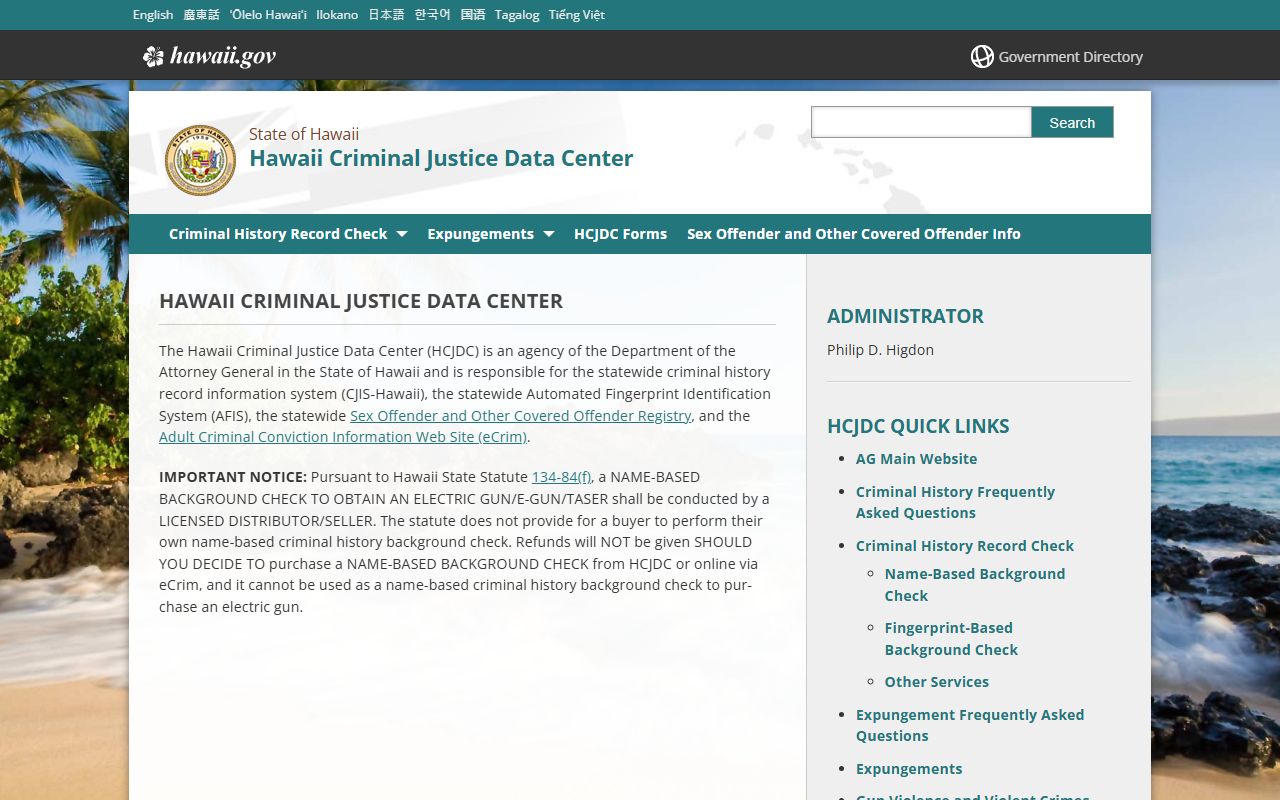
The HCJDC serves as the central repository for all criminal history record information in Hawaii, maintaining the eCrim system, AFIS, and the statewide sex offender registry.
Search Hawaii Felony Records Online
The fastest way to search Hawaii felony records is through eCrim, the state's Adult Criminal Conviction Information website. This portal draws from the HCJDC's criminal history files and lets you search for conviction records by name, date of birth, social security number, or gender. Each unique search costs $5.00. If you find a record you want to download, a full eCrim report costs $12. All steps must happen in one session. If you log out or stay idle for 30 minutes, your searches are gone and you have to start over. For help with eCrim, call (808) 587-3279 for data questions or (808) 695-4620 for technical issues. A YouTube video tutorial is also available on the eCrim site to walk you through the process.
eCrim only shows conviction records. Arrests that did not result in a conviction do not appear here. A result that says "No Criminal Convictions Found" is a valid and complete result. It means no conviction was found in the HCJDC files under that name. Non-conviction data stays protected under HRS Chapter 846 and is not part of the public eCrim system.
The Hawaii State Judiciary court records search is another way to look up felony cases. The eCourt Kokua system provides access to public information from District Court and Circuit Court criminal cases, Family (Adult) Court criminal cases, civil cases, Land Court, Tax Appeal Court, and appellate cases. You can search by case number, party name, or citation number. The system shows case summaries, docket entries, hearing dates, and case dispositions in real time. Personal identifiers such as social security numbers, birth dates, and home addresses are blocked from public view.
The Hawaii court records portal is the starting point for finding felony case details through the eCourt Kokua system.
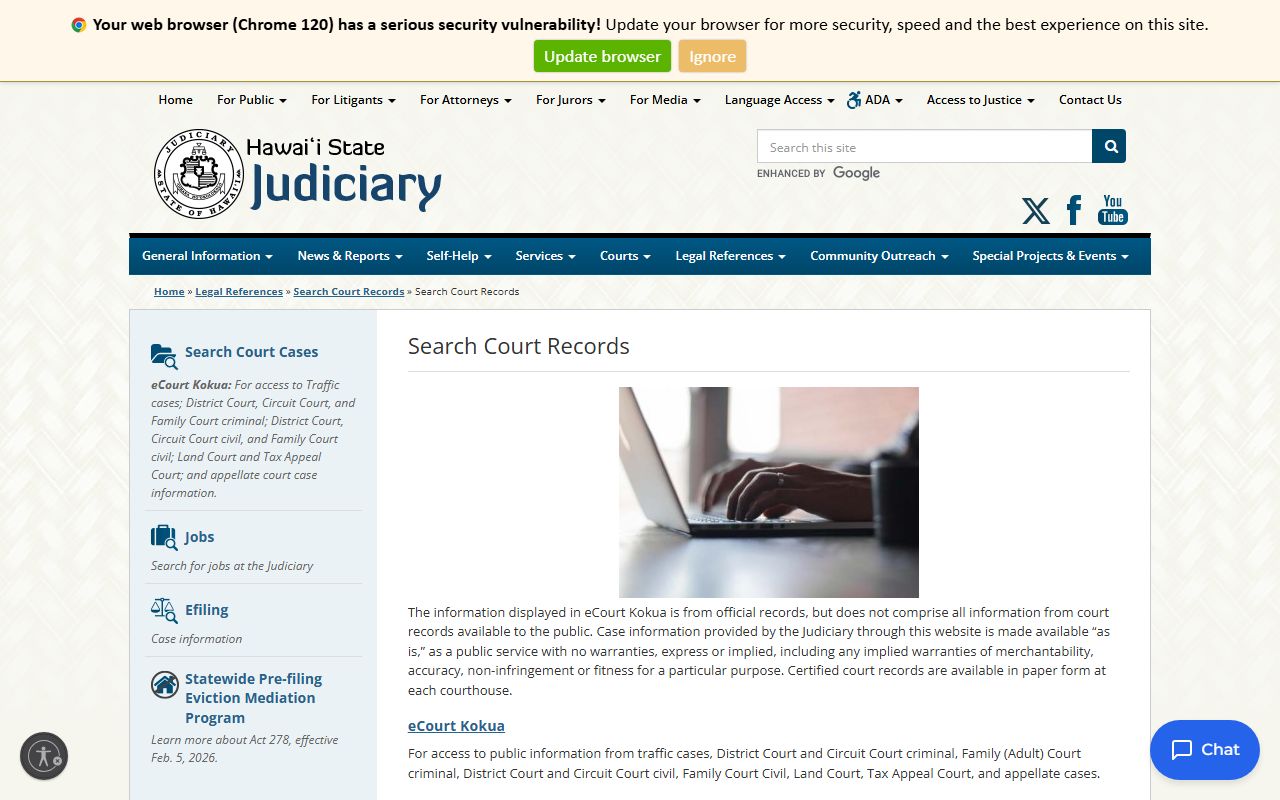
eCourt Kokua covers criminal cases from all four circuit courts, including felony filings, hearing dates, and case dispositions statewide.
A single document download from eCourt Kokua costs $3.00, with an additional $0.10 per page for documents over 30 pages. If you plan to search often, the Judiciary offers subscriptions at $125 per quarter or $500 per year. Certified court documents require an in-person visit or a written mail request. The fee for certified copies is $2.00 per page plus a $2.00 certification fee.
The Hawaii State Judiciary main site links to eCourt Kokua, courthouse information, and self-help resources for all four judicial circuits.
The Judiciary's website covers all four circuits: First Circuit (Honolulu), Second Circuit (Maui), Third Circuit (Hawaii Island), and Fifth Circuit (Kauai).
Public Access Sites for Felony Records
If you prefer to search in person, the HCJDC operates six public access terminals across the state. Each terminal lets you do a name-based search of conviction records from the statewide database. Every printed report costs $25. These terminals provide access to the same records available through the eCrim online system. Call the location ahead of time to check hours and terminal availability.
The six public access sites are at the HCJDC main office at 465 S. King Street in Honolulu, the Honolulu Police Department at 801 South Beretania Street, the Hawaii Police Department in Hilo at 349 Kapiolani Street, the Kona Police Station at 74-5221 Queen Kaahumanu Highway, the Kauai County Police Department at 3990 Kaana Street in Lihue, and the Maui County Police Department at 55 Mahalani Street in Wailuku. Residents on Molokai and Lanai use the Maui station. These terminals show adult conviction records only. Juvenile records and non-conviction data are not available at these sites.
Details on all six terminal locations are on the HCJDC public access sites page, with addresses and phone numbers for each site.
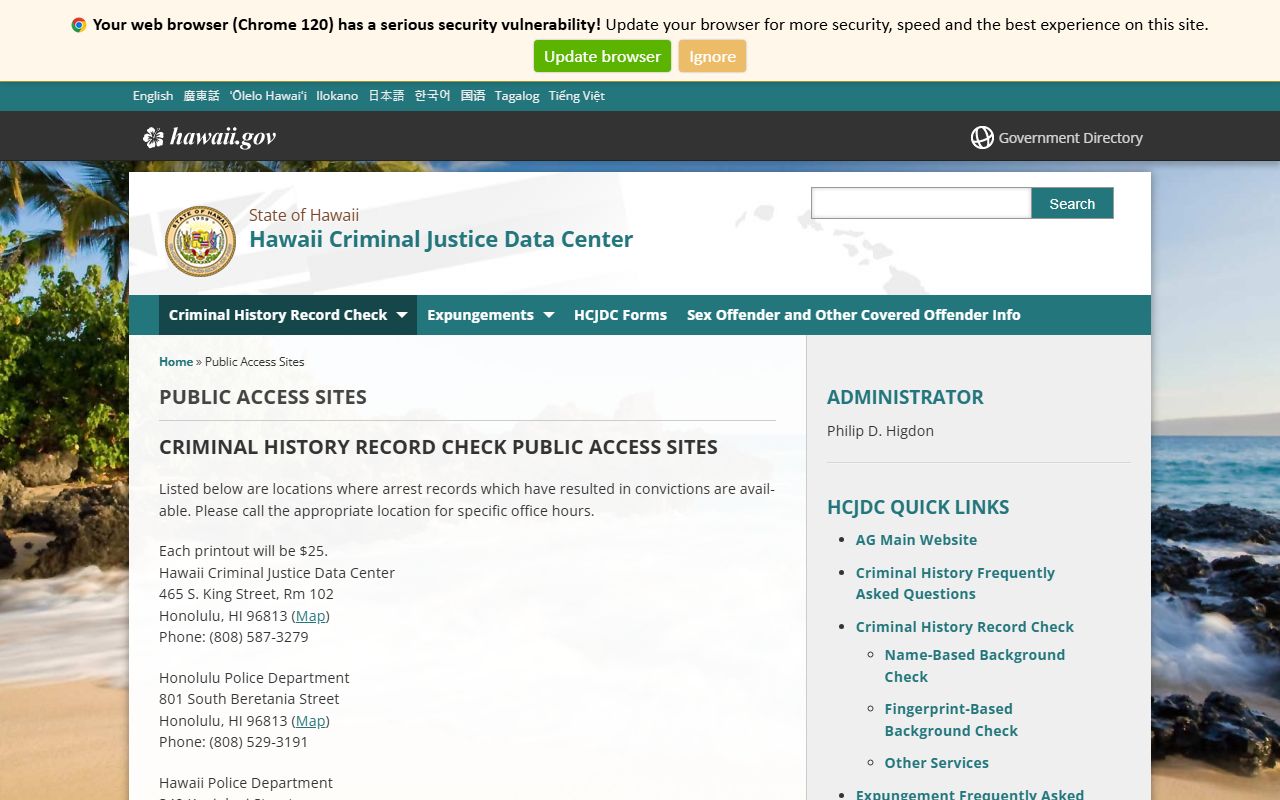
Public access terminals are spread across Oahu, the Big Island, Maui, and Kauai, giving residents on each island a local option for looking up felony conviction records.
Criminal History Record Checks
Beyond the public access terminals, the HCJDC offers direct record check services. In-person fingerprint checks at the Honolulu office cost $55, which covers both fingerprinting and the search. You need to call (808) 587-3279 to schedule an appointment. Certified copies of the result cost an additional $20. Notarized copies are included at no extra charge but take 7 to 10 business days. Payment is accepted by Apple Pay, credit and debit cards, money orders, and cashier's checks made out to the State of Hawaii. Cash is not accepted.
Mail requests are also an option. A name-based check by mail costs $30. A fingerprint-based check sent by mail costs $35. Certified copies are an extra $20 on top of those fees. Standard records are usually ready within 3 to 5 business days. For individuals without computer access, the HCJDC Honolulu office at 465 South King Street, Room 101, can process mailed requests for criminal history checks.
The Hawaii Attorney General's office sets the policy for all of these records services and maintains oversight of the HCJDC.
The Attorney General's office manages criminal justice data policy for the state, including the rules that govern who can request records and what fees apply.
Note: Under HRS § 846-2.7, the HCJDC is authorized to charge reasonable fees for criminal history record checks and to retain fingerprints for all authorized purposes.
Law Enforcement and State Agencies
The Hawaii Department of Law Enforcement was created on January 1, 2024, when the former Department of Public Safety was split into two agencies. The DLE took over all law enforcement functions, including the Sheriff Division, the Narcotic Enforcement Division, and the Criminal Investigator Division. The Sheriff Division phone is (808) 587-5002. The Sheriff Records office can be reached at (808) 587-5121. The DLE has statewide jurisdiction and operates on all islands.
The Hawaii Department of Law Enforcement site explains its divisions, UIPA records request procedures, and how to contact the department.
The DLE's Sheriff Division provides court security, serves legal process statewide, and works in coordination with county police departments across all islands.
To request records from the DLE, submit a UIPA request by email to law.uiparequest@hawaii.gov or by mail to 715 South King Street, Room 505, Honolulu, Hawaii 96813. Your request must include sufficient contact information, a description of the records you want, and your preferred method of delivery. The first $30 of fees is typically waived for Hawaii residents. Details are on the DLE UIPA records request page.
The DLE UIPA records request page walks you through exactly what to include when asking for government records from the department.
DLE records may include incident reports, administrative files, and other documents from the Sheriff and other law enforcement divisions operating across the state.
The Hawaii Department of Corrections and Rehabilitation took over the corrections side when DPS was split. The DCR manages all state correctional facilities with a focus on rehabilitation and reducing recidivism. The department currently spends roughly $190 million per year on Hawaii's correctional system. While DCR does not handle public criminal history record requests, information about individuals in state custody ties directly to the conviction records maintained by the HCJDC.
The Department of Corrections and Rehabilitation was created in 2024 alongside the DLE, replacing the former Department of Public Safety.
DCR manages seven facilities statewide, including the Women's Community Correctional Center in Kailua, which is undergoing major construction improvements.
Expunging Felony Records in Hawaii
Hawaii's expungement process is governed by HRS § 831-3.2. It allows certain arrest records to be removed from criminal history files. The process takes 120 days. There is no option for expedited service. The fee for a first-time application is $35, paid by cashier's check or money order made out to the State of Hawaii. Because expunged records are confidential, the HCJDC will not tell you over the phone or by email whether your application was received or where it stands. If your application is denied, you will get a notice by mail.
The HCJDC expungement information page covers eligibility, the application steps, and what happens after you apply.
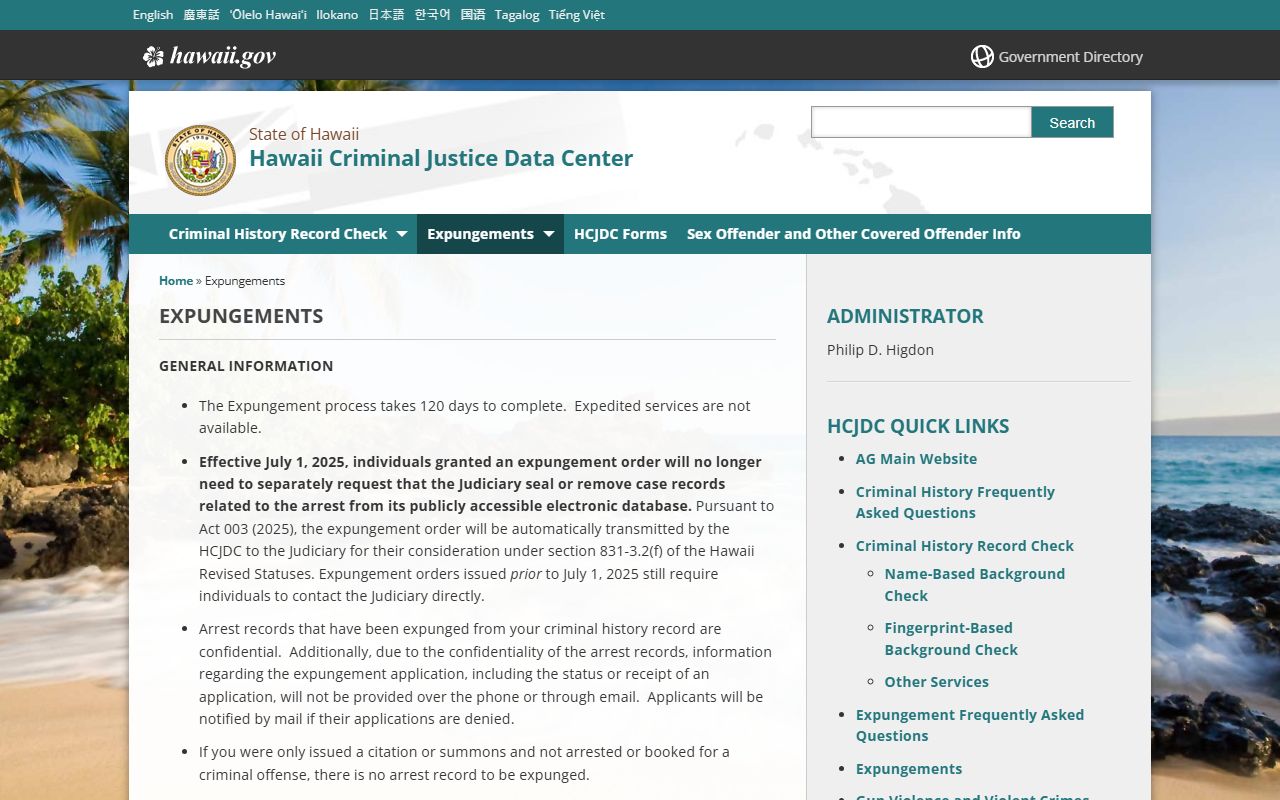
The HCJDC handles all expungement applications for the state, with a strict 120-day timeline and no fast-track option available.
Expungement in Hawaii applies to non-conviction arrest records, not to felony convictions themselves. You can apply if your case was dismissed, if a jury found you not guilty, or if no charges were filed at all. There are important limits. You cannot get an expungement if your case ended with bail forfeiture standing in for a conviction. If you left the state to avoid prosecution, you are also not eligible. For petty misdemeanor bail forfeiture cases, you must wait five years after the arrest. For cases resolved through deferred acceptance, the wait is one year after discharge.
Starting July 1, 2025, Act 003 (2025) changed how expungements work with court records. Before this law, you had to separately ask the Judiciary to seal the court records tied to an expunged arrest. Now the HCJDC automatically sends the expungement order to the Judiciary for their consideration. If your expungement was granted before July 1, 2025, you still need to contact the Judiciary directly to request removal of those court records. Only if you were issued a citation or summons without being arrested is there no arrest record available for expungement.
Access to Felony Records Under Hawaii Law
Hawaii's public records law is the Uniform Information Practices Act, found in HRS Chapter 92F. Under Section 92F-11, all government records are open to public inspection unless restricted by law. The default is openness. Records are public unless there is a specific legal reason to close them. This makes Hawaii's system relatively open compared to states where agencies have broader discretion to withhold information.
The Office of Information Practices is the state agency that administers the UIPA. It also oversees the Sunshine Law for open public meetings. The OIP provides free guidance to both the public and government agencies on records access questions.
The OIP offers an Attorney of the Day service where you can call (808) 586-1400 to get general advice on UIPA questions, usually within 24 hours, at no cost.
Section 92F-12 requires agencies to release specific records, including final opinions in adjudicated cases, information about the prosecution or formal charging of individuals, and records of pardons and commutations. These provisions open basic criminal case outcomes to public access under the UIPA, separate from the HCJDC's criminal history system. If an agency denies your request, you can appeal to the OIP. Their opinions are enforceable in court, and you do not need a lawyer to use the OIP process.
The UIPA page at OIP includes the full text of the law, formal opinions on how it applies, and resources for both the public and government agencies.
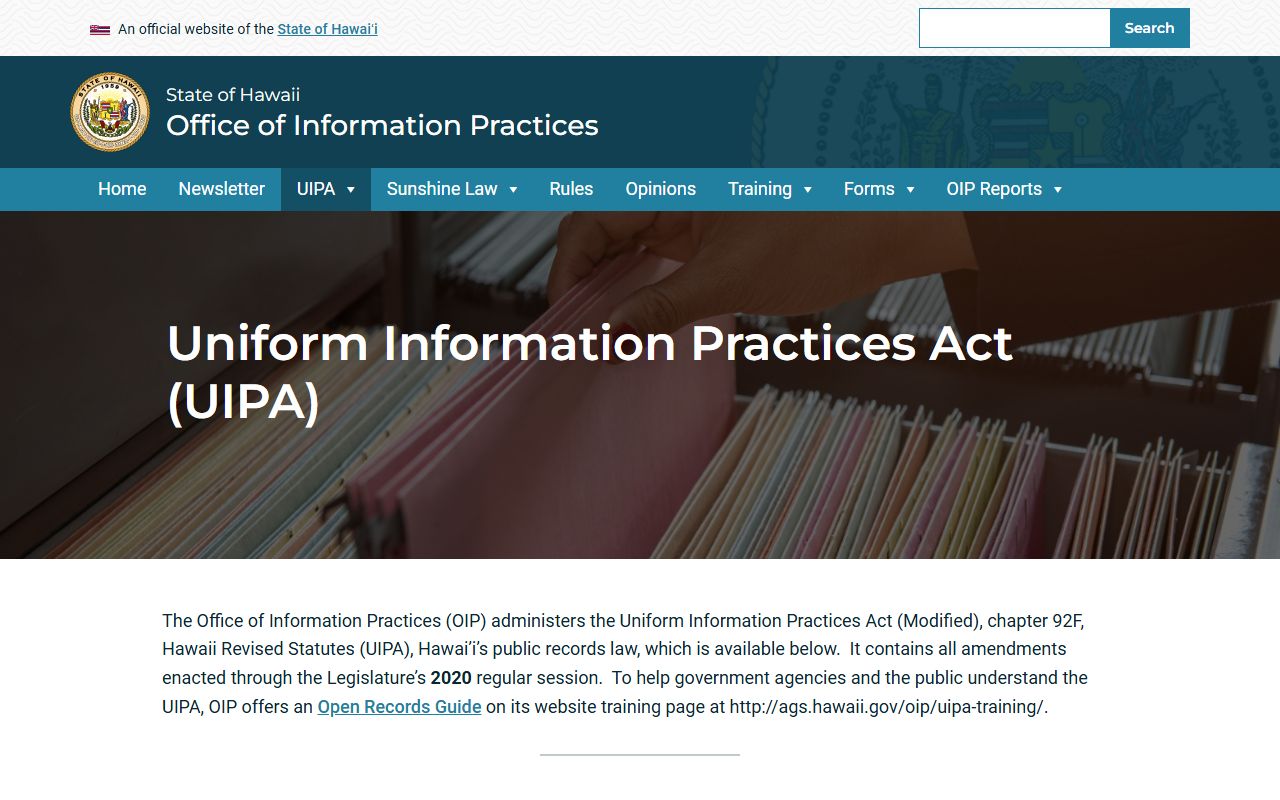
Chapter 92F, Hawaii Revised Statutes, is the foundation for public access to government records in Hawaii, covering criminal justice information alongside other government documents.
Not all records are open. Section 92F-13 protects records that would be a clear invasion of privacy, records related to ongoing law enforcement investigations, and records protected by other laws. Juvenile records are sealed under HRS § 571-84. Expunged records are also off-limits to public access. Medical, psychiatric, and financial records tied to a case may also be withheld.
VECHS: Criminal History Checks for Organizations
The Volunteer and Employee Criminal History Service, known as VECHS, allows qualified organizations to run fingerprint-based criminal history checks on people who will work with children, vulnerable adults, or individuals with disabilities. This program was created under the National Child Protection Act and Hawaii Act 196 from the 2014 session.
Information on how organizations can apply for VECHS access is on the VECHS program page at the HCJDC.
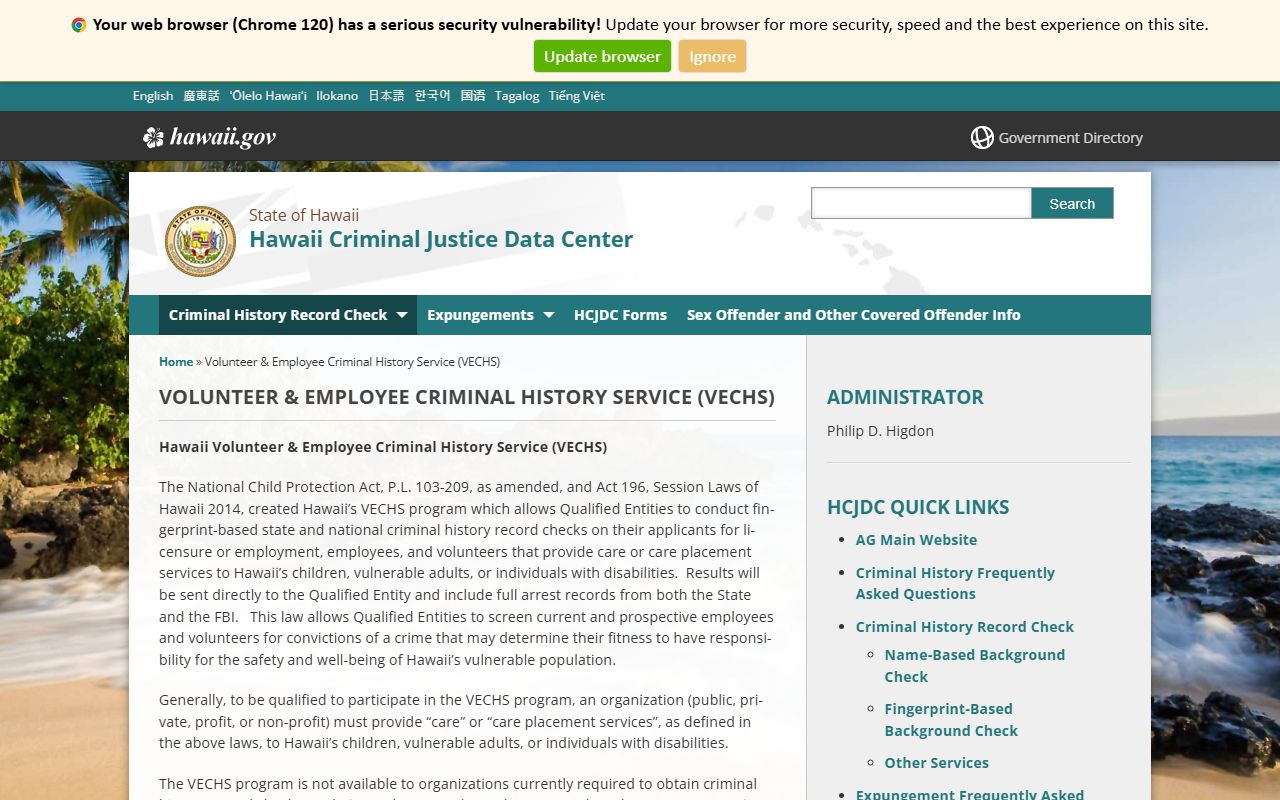
VECHS gives qualifying nonprofits and private care organizations access to full FBI and state criminal history records, including both arrests and convictions, for eligible applicants.
A qualified entity gets results that include both state-level and FBI criminal history. The program is not available to organizations that are already required by statute to run background checks through other procedures, such as day care centers or public school programs. To apply, an organization submits the VECHS Qualified Entity Application, signs the VECHS Agreement, and reviews the Criminal History Record Checks Policy Manual. Once approved, the entity receives a State-Issued Originating Agency Identifier and the forms needed to submit fingerprints.
Hawaii Felony Records Law: HRS Chapter 846
HRS Chapter 846 governs the HCJDC and the rules for disseminating criminal history record information. Section 846-9 addresses who can access records and on what terms. Conviction information can be shared with any person. Non-conviction data, meaning arrests that did not lead to a conviction, carries restricted access and is not available through public channels like eCrim or public access terminals.
The text of Hawaii Revised Statutes § 846-2.7 sets out who may conduct criminal history record checks and what procedures apply.
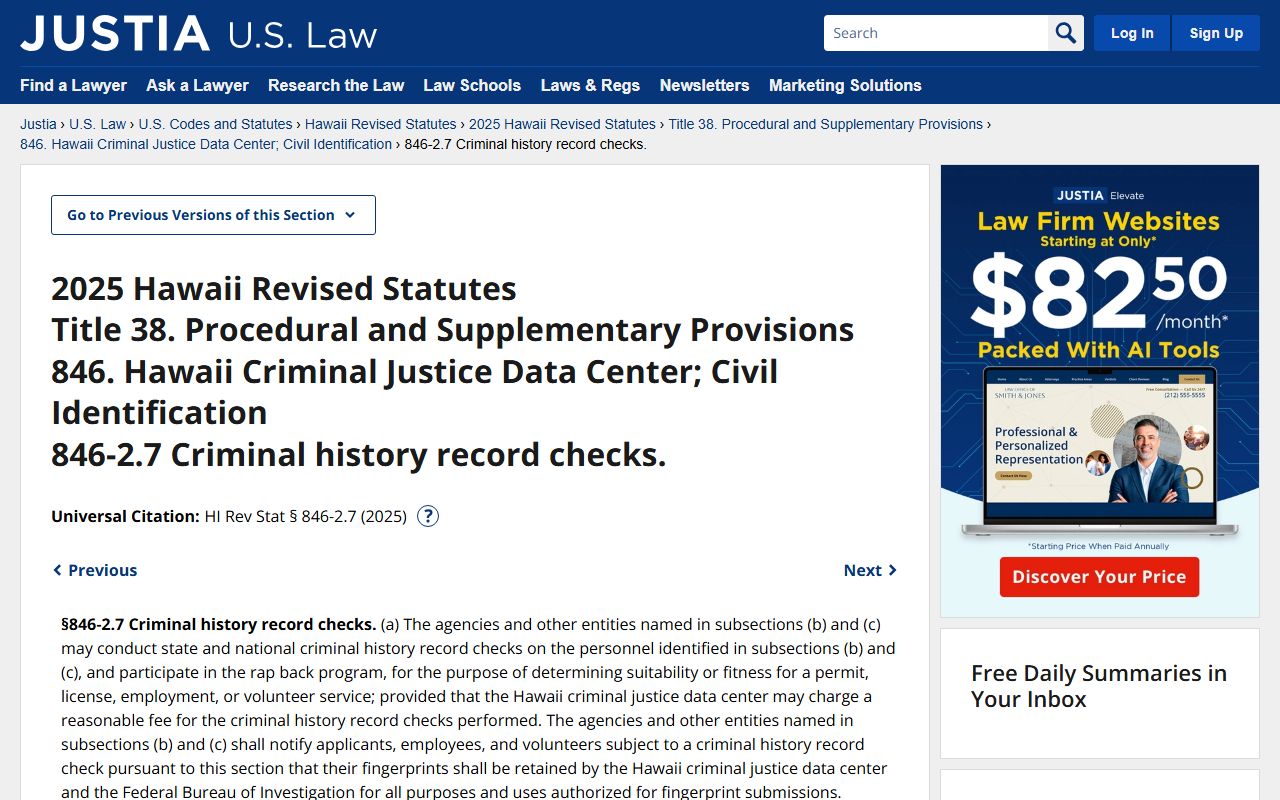
HRS § 846-2.7 authorizes specific agencies and entities to run state and national criminal history checks and requires fingerprints to be retained by both the HCJDC and the FBI for all authorized purposes.
Officers and employees of the HCJDC are prohibited from disclosing records to anyone not authorized to receive them. Anyone who gets criminal history information from the HCJDC is also barred from passing it to unauthorized parties. These rules protect the integrity of the records system.
Court records follow different retention schedules. Felony cases are kept for 75 years from final disposition. Misdemeanor cases are retained for 25 years. Petty misdemeanor and violation cases are held for 10 years. These schedules mean that felony records from decades ago are still accessible and part of the public record at the appropriate courthouses.
Note: eCrim shows adult conviction records only. Non-conviction data and juvenile records are not accessible to the public under HRS Chapter 846 and § 571-84.
Browse Hawaii Felony Records by County
Hawaii has five counties, each with its own circuit court and police department. Pick a county below for local contact details and resources on finding felony records in that area.
Felony Records in Major Hawaii Cities
Criminal cases in Hawaii are filed at the circuit court for the county where the offense occurred. Pick a city below for local resources on accessing felony records in that area.